KNX distribution board construction is the invisible foundation on which the reliability of every intelligent building rests. A modern smart home or commercial building is becoming ever more complex: lighting, heating, blinds, ventilation, air conditioning, security systems and multimedia have to act as a harmonious unit. But the real stability of these systems is not decided by the elegant push buttons on the wall or stylish touch panels in the living area. It is decided deep inside the central distribution board.
It is exactly here, in the physical enclosure of the automation, that serious mistakes often arise unnoticed during planning and assembly. The consequences usually show up only after months or years of daily operation. Correcting them afterwards, or completely rewriting an unstructured system, is almost always associated with immense costs that could have been avoided by forward-looking engineering from the start.
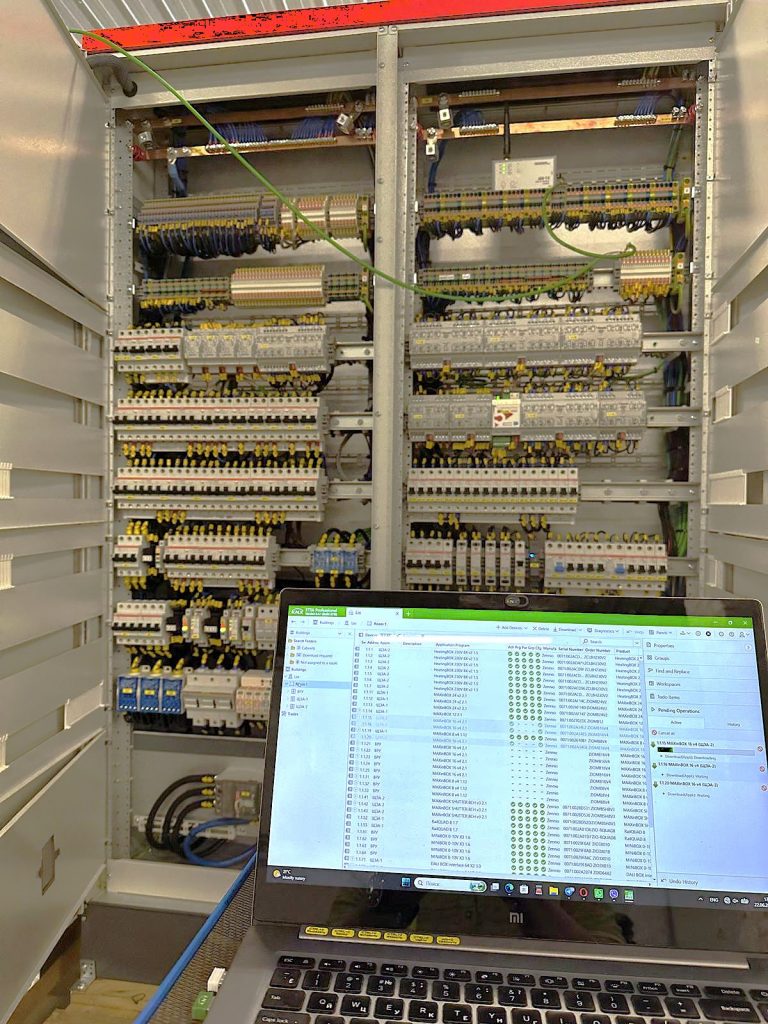
The most critical mistakes in the control cabinet and how to avoid them
Mistake 1: An enclosure calculated too tightly
By far the most common mistake in practice is choosing a control cabinet “right on the edge”. During construction or after moving in, the owner almost always comes up with new wishes: additional sensors, the integration of a new PV system, the control of a wallbox for the electric vehicle or additional garden lighting. If there is no space, every extension becomes a planning disaster.
Expert tip: in KNX distribution board construction, plan a space reserve of at least 20% to 30% in the control cabinet from the start.
Mistake 2: No logical system structure
When circuit breakers, terminal blocks and KNX actuators are thrown together without a clear system, even the most experienced system integrator loses track after a few years. Professional KNX distribution board construction is characterized by strict visual segmentation.
Expert tip: consistently divide the control cabinet into functional zones: the power section with fusing, the KNX infrastructure devices (power supplies, IP routers), the actual switching and dimming actuators, and a separate area for the network technology.
Mistake 3: Poor or incomplete labeling
Circuit breakers that are only marked with handwritten abbreviations are not enough for a smart building. Every single wire, every terminal from manufacturers such as Phoenix Contact and every bus device must be permanently and clearly machine-labeled. Only then can a fault be narrowed down during later maintenance or troubleshooting without a long search.
Mistake 4: Neglecting the thermal conditions
Modern switching actuators, powerful power supplies and IP routers develop noticeable power loss in the form of heat during continuous operation. If heat builds up in the closed enclosure, the lifespan of the expensive electronic components drops drastically and the risk of unpredictable system failures rises.
Expert tip: already during the planning of KNX distribution board construction, the thermal load must be calculated and, if necessary, active, temperature-controlled control cabinet ventilation must be planned.
Mistake 5: No power reserves in the system devices
The KNX power supply is the heart of bus communication. If it is operated too close to its maximum load limit, telegram losses and irregular bus faults are a risk. Make sure to choose power supplies with sufficient current to supply future line extensions without problems.
Quality features of a masterfully built distribution board
A flawless and clean KNX distribution board can be recognized at first glance, even without in-depth electrical engineering knowledge:
Tailor-made engineering for demanding architecture
That standardized off-the-shelf distribution boards rarely meet the requirements of modern architecture is shown by the daily practice of AGR Technologies GmbH. Every demanding project calls for individual dimensions and intelligent solutions.
In realized projects, our engineers deliberately reduce the height of the enclosures compared with typical standard cabinets, for example, to fit the technology perfectly into architecturally limited niches or low technical rooms, without compromising clarity or VDE-compliant execution. All components remain optimally accessible for maintenance work, and the logic of the system stays immediately understandable to any technician even after decades.
Conclusion
KNX distribution board construction, as the central hub, decides the success of your entire smart home project. Anyone who saves on engineering, enclosure size or craftsmanship pays extra later with every extension or troubleshooting.
AGR Technologies GmbH designs, calculates and manufactures tailor-made control cabinets in its own factory to the highest quality standards. We realize automation solutions with system components from leading manufacturers such as ABB and Zennio for private residences, modern office complexes, banks and medical facilities across Europe.

Author: Alexander Zalesskiy, Senior KNX Consultant at AGR Technologies GmbH, with over 20 years of experience in building and automation technology.
Planning a KNX distribution board?
Call us or write on WhatsApp. We will get back to you with a first technical assessment.
AGR Technologies GmbH is a partner of: